
Numbers, precision and tolerance
Precision
Section titled “Precision”Numbers are kept as standard double-precision floating point, about 15 to 16 significant figures, real and complex alike. That is far more than any engineering input is known to, so rounding inside a calculation never matters in practice; what you see is rounded only for display (How results are shown).
A few things follow from floating point:
0.1 + 0.2is not exactly 0.3 inside, but comparisons allow for it (below).- Very large and very small results are still correct, and shown with an exponent.
- Division by zero is an error, not infinity.
The symbolic arrow → works exactly, with fractions: x/2 + x/3 → 5*x/6. float turns an exact result into a decimal.
Tolerance
Section titled “Tolerance”Comparisons (==, <, <=, >, >=, !=) treat numbers within a small relative tolerance as equal. The tolerance is the built-in variable TOL, 10⁻³ by default:
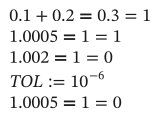
As text
0.1 + 0.2 == 0.3 = ?
1.0005 == 1 = ?
1.002 == 1 = ?
TOL := 10^-6
1.0005 == 1 = ?
Change it for the whole sheet with the tolerance setting, or from one point on with TOL := ….
Roots of negative numbers
Section titled “Roots of negative numbers”(-8)^(1/3) is the principal complex cube root, 1 + 1.732i, as in most mathematics. For the real root, use nthroot:
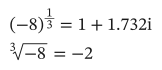
As text
(-8)^(1/3) = ?
nthroot(-8, 3) = ?