
Solving equations
One equation, one unknown
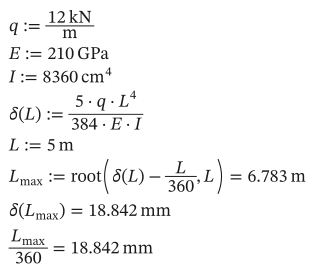
Section titled “One equation, one unknown”How long can the beam from the beam example span before it deflects more than L/360? Write the deflection as a function of the span, guess a span, and ask root for the span where the difference is zero:
As text
q := 12 kN/m
E := 210 GPa
I := 8360 cm^4
δ(L) := 5*q*L^4/(384*E*I)
L := 5 m
L_max := root(δ(L) - L/360, L) = ?
δ(L_max) = ?
L_max/360 = ?
root(f, x) starts from x’s current value, the guess, and looks for a value of x where f is zero. The result has x’s unit.
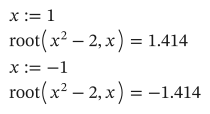
An equation can have several roots; the guess decides which one you get:
As text
x := 1
root(x^2 - 2, x) = ?
x := -1
root(x^2 - 2, x) = ?
To be sure of the interval, give it instead of a guess: root(f, x, a, b) finds a root between a and b, where f must change sign.

As text
root(δ(L) - L/360, L, 1 m, 20 m) = ?
For the roots of a polynomial, all at once, see polyroots in Solve equations.
Several equations: a solve block
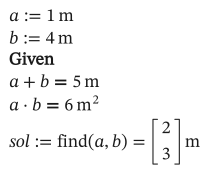
Section titled “Several equations: a solve block”Two numbers whose sum is 5 m and whose product is 6 m²:
As text
a := 1 m
b := 4 m
given
a + b == 5 m
a*b == 6 m^2
sol := find(a, b) = ?
- Give each unknown a guess.
- Type
givenand a space. Below it, write the conditions, using the bold equals Ctrl+= (written==), or<,>,≤,≥. - Finish with
find(a, b): the values that meet every condition, as a column.
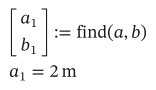
To name the results one by one, put the names in a vector on the left:
As text
[a_1; b_1] := find(a, b)
a_1 = ?
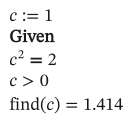
Like root, find starts from the guesses, so they choose the solution: with b := 1 m too, it can’t tell the two answers apart and reports that it found no solution. Inequalities help to steer it:
As text
c := 1
given
c^2 == 2
c > 0
find(c) = ?
When the conditions can’t all be met, minerr gives the values that come closest, where find would report an error. For optimising (Minimize, Maximize), see Solve equations.