
Angles and money as dimensions; your own units
Angles as a dimension
Section titled “Angles as a dimension”By default, an angle is a plain number in radians. For sheets where it matters (a rotational stiffness is not a moment), turn on Format → Units → Angles as a dimension, or write at the top of the file:
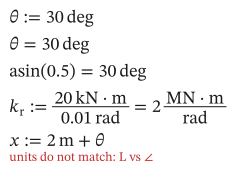
---angle: dimension---Then rad is a unit like the metre, and angles are checked:
As text
θ := 30 deg
θ = ? deg
asin(0.5) = ? deg
k_r := 20 kN*m/(0.01 rad) = ? MN*m/rad
x := 2 m + θ
sin,cosandtantake an angle (or a plain number, read as radians);asin,acos,atanandatan2give one.- An angle result is shown in degrees unless you ask for another unit;
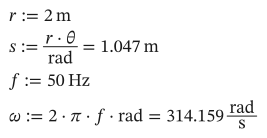
angle_display: radshows radians instead. - Formulas where the radian quietly disappears need it written. An arc length is
r*θ/rad, and an angular frequency2*π*f*rad:
As text
r := 2 m
s := r*θ/rad = ?
f := 50 Hz
ω := 2*π*f*rad = ? rad/s
Money as a dimension
Section titled “Money as a dimension”Name your currency, with Format → Units → Currency…, or at the top of the file:
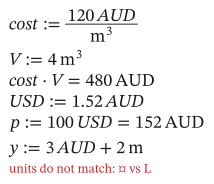
---currency: AUD---That name becomes a unit, and money is checked like anything else:
As text
cost := 120 AUD/m^3
V := 4 m^3
cost*V = ?
USD := 1.52 AUD
p := 100 USD = ?
y := 3 AUD + 2 m
Other currencies are definitions with your own rate; Beermat fetches no exchange rates. Money never takes prefixes (no “kAUD”).
Your own units
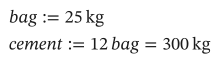
Section titled “Your own units”A unit is a value with a name, so a unit of your own is a definition:
As text
bag := 25 kg
cement := 12 bag = ?
It can be used below where it is defined, like any variable, and in a result’s placeholder (= ? bag).