
Units
Every number in Beermat can carry a unit, and the units travel through the calculation with it.
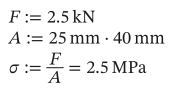
As text
F := 2.5 kN
A := 25 mm*40 mm
σ := F/A = ?
Typing units
Section titled “Typing units”A unit goes straight after its number: 6 m, 12 kN/m, 8360 cm^4. In the editor you needn’t type the space: 6m becomes 6 m. A unit is just a name multiplied by the number, so compound units are written as you would on paper: kN*m, m/s^2, kg/m^3.
The units reference lists every built-in unit: SI with its common prefixes, US customary units, and a few others (bar, t for the tonne, L for the litre).
Showing a result in another unit
Section titled “Showing a result in another unit”With no unit asked for, Beermat picks one from SI, with the prefix that keeps the number readable:
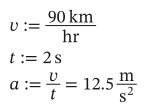
As text
v := 90 km/hr
t := 2 s
a := v/t = ?
To see a result in a unit of your own, type the unit after the =. It goes into the placeholder at the end of the result and stays there:
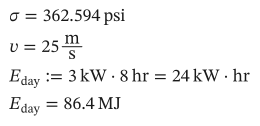
As text
σ = ? psi
v = ?
E_day := 3 kW*8 hr = ? kW*hr
E_day = ? MJ
Any unit of the right kind works; the calculation inside doesn’t change, only what is shown.
The mistakes units catch
Section titled “The mistakes units catch”Adding a length to a time is almost always a typo or a missing term. Beermat refuses it and says why:
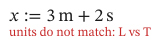
As text
x := 3 m + 2 s
The letters are the dimensions: L length, M mass, T time, I current, Θ temperature, N amount of substance, J luminous intensity. A wrong unit in the placeholder is caught the same way:

As text
σ = ? kN
Things of the same kind mix freely: 3 m + 250 mm is 3.25 m.
Gravity, grams and other clashes
Section titled “Gravity, grams and other clashes”A few unit names are also common variable names. Beermat settles them like this:
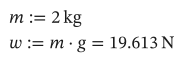
gis standard gravity, 9.80665 m/s². The gram is the upright g, a different name: typeg, then Ctrl+I, which turns a plain (italic) name upright. In a file it is written\rm g(name styles).kgandmgare as usual.Lis the litre,tthe tonne,mthe metre,sthe second.
You can still use these names for your own variables: L := 6 m makes L the span from there on. But a unit you redefine is no longer that unit below it. After m := 5, 3 m is 15, not three metres. If a result suddenly looks wrong by a large factor, look for a variable named like a unit.
As text
m := 2 kg
w := m*g = ?
Angles
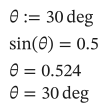
Section titled “Angles”Angles are plain numbers in radians, and deg is π/180:
As text
θ := 30 deg
sin(θ) = ?
θ = ?
θ = ? deg
To make angles a dimension of their own, so that a rotation can’t be added to a length, see Angles and money as dimensions.
Temperatures
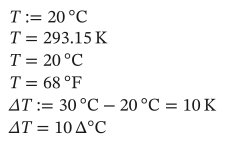
Section titled “Temperatures”°C and °F are scales: 20 °C is the temperature 293.15 K. A difference of temperatures is in kelvin, or Δ°C:
As text
T := 20 °C
T = ?
T = ? °C
T = ? °F
ΔT := 30 °C - 20 °C = ?
ΔT = ? Δ°C
Inside a compound unit, °C is a degree of difference: a conductivity in W/(m*°C) means what it says.
Your own units
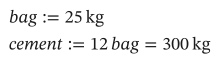
Section titled “Your own units”A unit of your own is a definition like any other, usable below it:
As text
bag := 25 kg
cement := 12 bag = ?
Taking the unit off
Section titled “Taking the unit off”To use a value where a plain number is needed (in a lookup table, or a formula from a code that assumes units), divide by the unit:
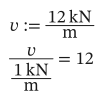
As text
v := 12 kN/m
v/(1 kN/m) = ?